Garden Project: Finished. . . And Lessons Learned

It’s finished!

If you haven’t seen the beginning of this project, check out the first three posts: New Beginnings, Getting There, and So Close.

After installing all the cages on the garden beds, I took a trip to The Herb Farmacy in Salisbury, MA. It’s always fun and interesting to browse the selections in their greenhouses. They’re the gardner’s version of a candy store! I chose some tomato, cuke, zucchini, and butternut squash plants. I also picked up a couple of nasturtiums and basil.

The zucchini and cuke plants now share space in one of the tall-caged beds, beside the peas, along with one of the nasturtiums.

In the other tall-caged bed, I put the two tomato plants and the basil. It’s hard to imagine these small seedlings will fill the space I’ve given them. It’s tempting to put too much, too close together. In the past, I’ve done just that and ended up with a garden jungle! This year, I’m trusting the process. πŸ™‚

The butternut squash and the 2nd nasturtium went into one of the low-caged beds in front of the strawberries.

Meanwhile, the spinach, kale, lettuce, beets and carrots are getting bigger, although recently assaulted by a blizzard of helicopter seeds.

Finally, it was time for the finishing touches. I planted marigolds in the cinder blocks outside the beds, then laid landscape paper and spread mulch around and in-between the beds. I splurged on the final embellishments: lovely potted pink geraniums placed on paving squares at a few outside corners.

The end result is just what I envisioned (well, pretty darn close, at least) and I’m looking forward to an easier, more productive gardening season this summer. I’ll leave you with a random list of things I learned during my garden-bed-building adventure:

  1. It takes hard work to bring a plan to fruition. Sometimes it’s fun. Sometimes it’s just hard.
  2. When you go to the local home improvement store to find nails similar to the ones you had on hand, but used up, be prepared to encounter a few well-meaning males who want to explain to you that a two-by-four is really only 1 1/2″ thick. (Thank you so much. <eye roll>)
  3. If you don’t buy all the nice cedar boards that you need in one trip, they may very well be gone next time you go looking for them. (sigh)
  4. You can’t construct a perfectly square corner with two bowed boards.
  5. Hardware cloth is not cloth at all.
  6. Your math-brain may see half-inch hardware cloth as a beautifully squared grid, like graph paper, but it’s not.
  7. If the website doesn’t say SCREENED loam, it’s not.
  8. Close is good enough sometimes.
  9. There’s no shame in asking for help.
  10. It takes hard work to bring a plan to fruition… but it’s so worth it in the end. πŸ™‚

Garden Project: So Close…

One of the greatest joys of this current garden project is that I set a goal, listed the interim steps in detail, gave myself a rough timeline, and have been sticking to it. The end product is in sight. If you want to read about the beginning of the project, check out New Beginnings and Getting There.

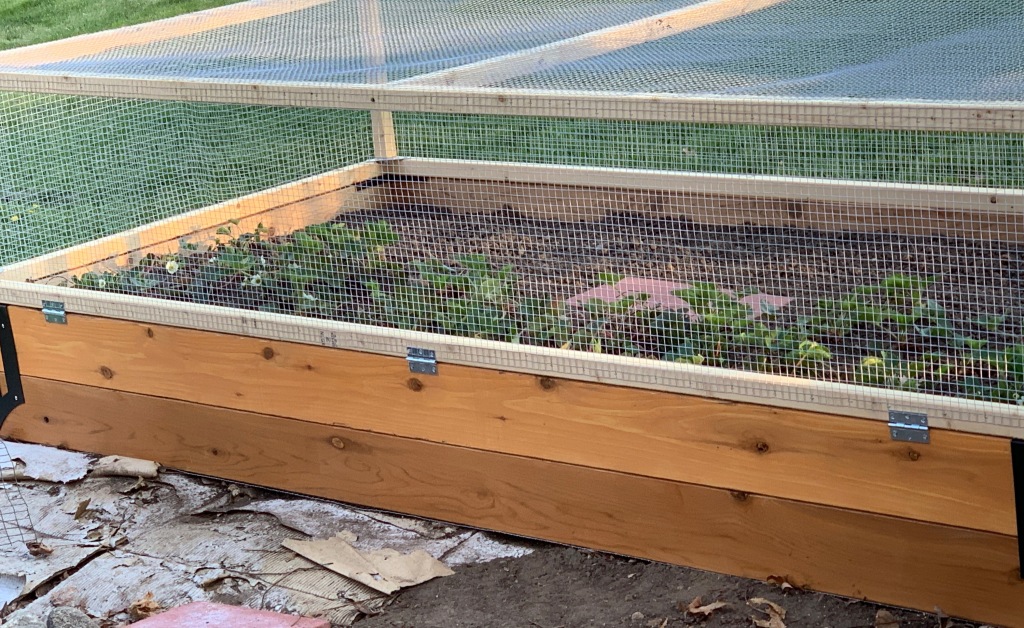
Something was eating the strawberry plants. At first, we set the short cages over them, just to keep them safe. But now hinges and chains have been installed on the short cages making them easy to open and close. I’m not 100% sure that the bees are getting through the cage openings, so I’ve been propping them open during the day. I’m looking forward to harvesting ripened strawberries this year, instead of having to pluck them early before the chipmunks and squirrels steal them.

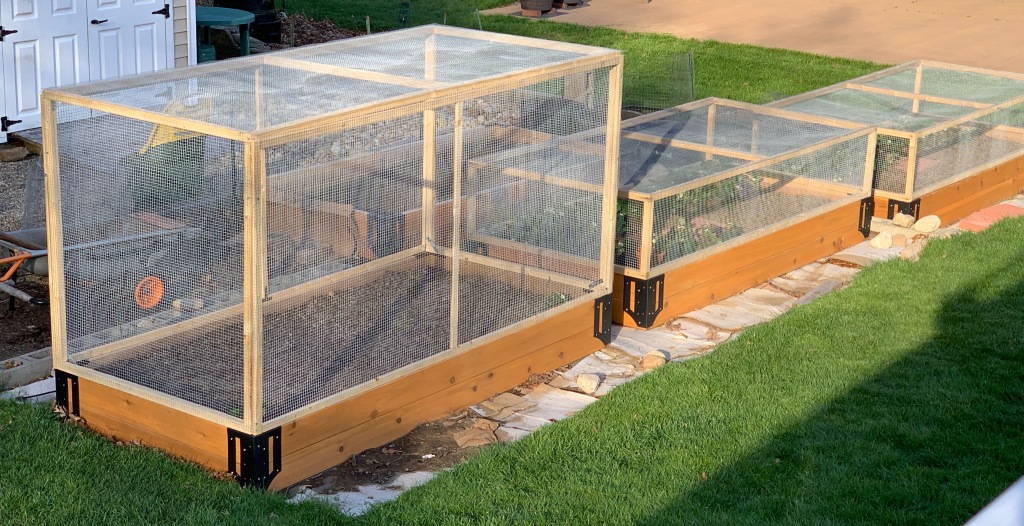
The third and fourth beds will house taller plants, like tomatoes and zucchini. The frames of the taller cages are shaped like four-foot staples. (I have staples on the brain after attaching so many sections of hardware cloth!) The first tall cage was installed on the third garden bed using hooks and eyes, last week. Two flat, removable panels were attach to either side and secured with a simple combination of screws and wire.

This weekend, I managed to fill the 4th bed with soil, finally deciding to screen out a good deal of rocks and debris as I did so. It made the job harder, but was certainly worth the effort. Then, with the help of my husband, we secured the 2nd tall cage to the 4th bed and installed the two flat panels to close the cage. Finally, I attached old cabinet handles to the short cages to finish them.

What a sight to see β€” all four garden beds filled and covered and ready for the growing season.

Snow peas, potatoes, spinach, and kale have already been planted and are starting to come up. I still need to spruce up the area around the beds, but I’ve got time. In the next week or two, I’ll be taking a trip with my gardener-friend, Dawn, to the Herb Farmacy in Salisbury, MA, to pick up organic tomato and squash plants. I’m so looking forward to this new gardening adventure and hoping these new beds with their cages will make gardening a little more productive and fun.

Stay tuned for the final installment of Garden Project, when everything is planted and I’ve added the last few finishing touches. In the meantime, happy gardening! πŸ™‚

Garden Project: Getting There

In Garden Project: New Beginnings, you can find a description of the beginning of this project.

Assembling four 4′ X 8′ boxes out of cedar was only the first step. I needed these garden beds to be critter proof if they were going to serve their purpose. So, I ordered a roll of hardware cloth, which isn’t cloth at all. It’s metal fencing, similar to chicken wire, but stronger. I decided on the roll with 1/2″ mesh β€” great for rain and sun and bees to get through, but not so for the smallest of chipmunks.

All this hardware cloth needed to be cut to size and stapled onto the bottom of the boxes as well as onto the frames of the cages (more about them in a minute). So, I bought a new wire cutter and went to town on the hardware cloth.

I had a couple of old Craftsman hand-staplers, but trying to find staples for them turned out to be more of a headache than it was worth. They seemed better suited for affixing yard-sale signs to utility poles than metal fencing to a 2″ X 6″ anyway. My daughter had a newer, more sturdy stapler. Hers was better suited for the job, but hard to use (with my small hand).

Thankfully, a neighbor stepped up and offered the use of their pneumatic staple gun. A total game-changer!

The cage designs took a little thought. They needed to be sturdy enough to hold up under the hardware cloth, but not so bulky that they’d block sunlight from the gardens. To save on both wood and fencing, I decided to make two of the cages about eighteen inches high, since they’d be protecting strawberry plants and other low plants, like carrots, beets, and leafy greens. I could even put squashes, like butternut or pumpkin, under these low cages.

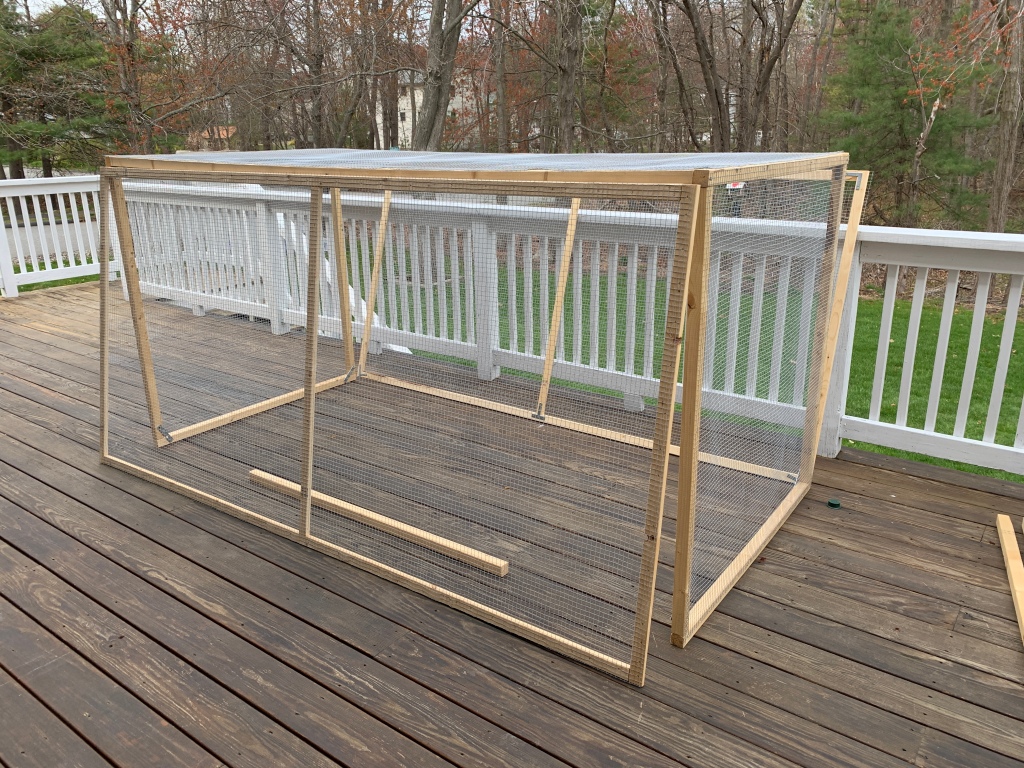
Two of the cages needed to be high enough for taller plants. These would be four feet high, since that’s the width of the hardware cloth and also half the length of the boards I could buy for the cage frames. Would I do doors on the tall cages? That seemed like a lot of work and would require even more wood to frame the doors. Instead, I settled on removable front and back panels, so I could access the plants from both sides.

Picking through 1″ X 2″s and 2″ X 2″s to find the straightest ones was even harder than finding straight cedar boards. We (my daughter and I) settled for mostly straight. We quickly realized how many metal mending brackets (straight ones, L-shaped, T-shaped, and corner ones) we’d need to make these cages stable. Some brackets came with their own screws, but others left us rummaging through our own supplies of random leftover screws. We started with the low cages.

Again, the work was subject to the weather, but we managed to get the two low cages built and covered with hardware cloth. The tall cages aren’t complete, yet.

Meanwhile, the cedar boxes needed to moved off our back deck to clear a space for building the cages. The old garden still needed to be dismantled, the new beds filled, and the strawberries transplanted.

It snowed the day my order of loam and compost was supposed to be delivered. So, they delivered it the following day. The compost was in great shape, but the loam was soaked and clumped like clay. Disappointing, not to mention heavy and hard to shovel.

The snow day gave me a chance to fix a casualty of too much bending over to staple hardware cloth.

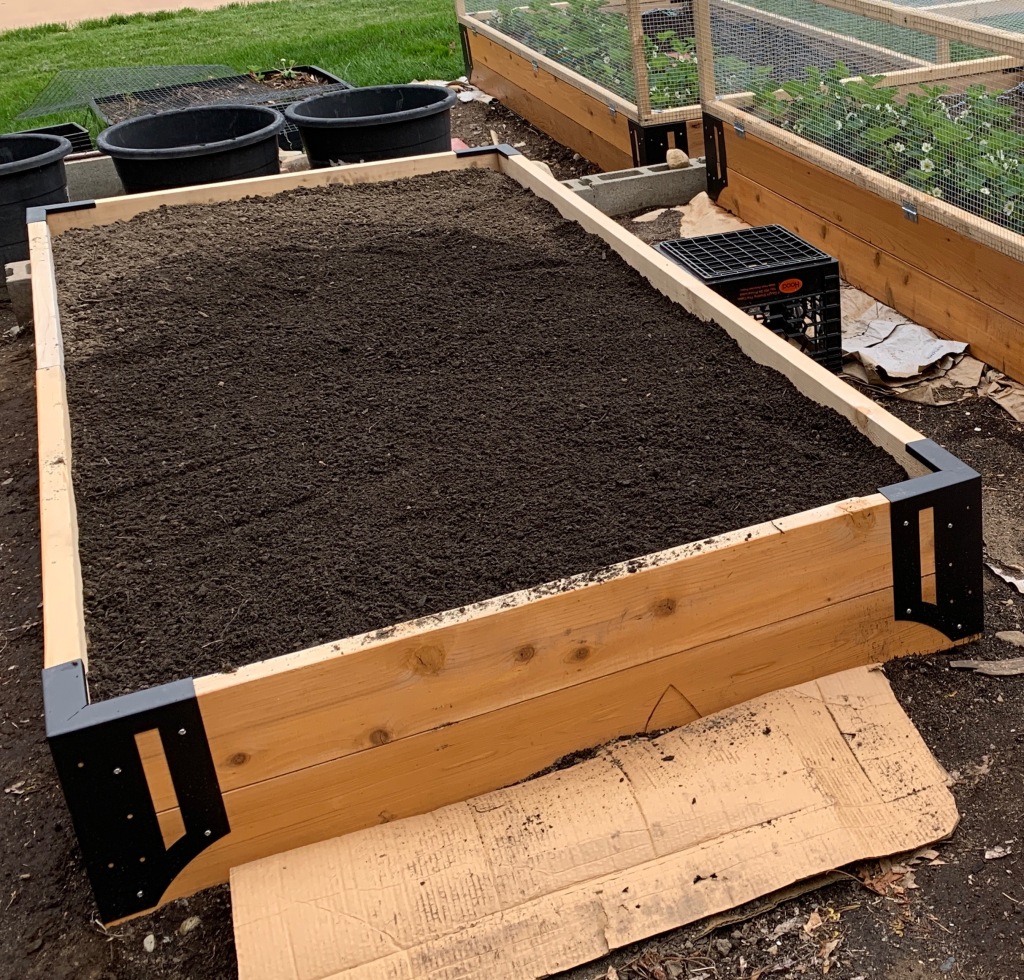
Each 4′ X 8′ garden bed took hours for me to fill by myself. The first two took a full day each. I got help with the third one. And the fourth is still sitting empty. A lot of measuring and leveling was included in placing the beds and prepping them to be filled. The yard slopes (as most yards probably do) so a two-tiered garden space made sense. I used cinder blocks that had bordered the former garden space to divide the levels.

The strawberries, which have begun to flower, have been transplanted β€” just in time, apparently. Some animal (deer maybe?) has started nibbling. The small cages need to be attached with hinges as soon as possible.

Hopefully, in the next week or so, the tall cages will be done so the peas and a few other early crops can be started. Eventually, when all the veggies are safe in their caged beds, I’ll be able to clean up the area and top it off with some attractive mulch and flowers. Stay tuned!

First Month Check-in

We’ve come to the end of the first month of this new year. The year still feels new-ish, despite some lingering difficulties from 2020. And it’s a good time to check in with our goals and expectations for 2021. (Notice I didn’t use the word resolutions. Goals sound more hopeful, don’t you think?)

Did you set some goals β€” general or specific, long or short-term, written down or mentally noted β€” at the beginning of this year? How’re you doing with them? I’m not here to judge, believe me. Instead, I encourage you to ask yourself that question. And if you didn’t set any goals, it’s not too late, you know. Never is. Like I’ve said before, just make them realistic and achievable.

One of my goals is to create new garden beds before this year’s planting season, complete with rodent-proofing. After several design attempts and pricing quotes, I’ve settled on building them myself (with some much appreciated help). The wood has been purchased, other supplies will be purchased soon, and construction will begin in my daughter’s garage (since that’s where the saw is. πŸ™‚ ) It feels good to take steps toward the final goal. Each step is an accomplishment in itself.

I’ve also made progress on some of my writing goals already (although a few have been put off until after the garden beds are built). Today also marks the end of Storystorm, hosted by Tara Lazar, a realized goal of mine in which I had to come up with a picture book idea every day for the month of January. Challenging! And another goal is to create a collage using a new (to me) painting technique. Again, I’ve taken steps in the direction of this goal. (See the photo above.) It’s been fun, stretching my creative muscles! And it’s been a great distraction on cold, snowy days.

Setting goals and reaching for them is worth the effort. However, life is a process, and sometimes goals need to be revisited, adjusted, and refined. That’s ok.Β  But I encourage you to care for yourself, and those around you, by living with purpose, setting goals and taking daily or weekly steps toward them. Every small accomplishment can be satisfying. And if you’ve taken steps toward one of your 2021 goals, give yourself credit. Celebrate your success. And have a happy new year!

Nature Abhors A Garden

It’s true. Every spring I succumb to the urge to plant seeds and watch them grow. And by July I’m questioning my sanity.

It starts in March when, feeling a bit like a kid with the Sears toy catalog at Christmas, I order my seed potato from Wood Prairie Farm in Maine. I dream of what else I will plant and where. The possibilities seem endless. The snow melts to reveal the garden beds and I salivate at the thought of this year’s crops.

In April and May, starting seeds indoors brings daily doses of joy as the tiny sprouts push up from the soil and transform into healthy green seedlings. Venturing to the local Herb Farmacy for a few organically grown tomato plants beats a trip to the candy store any day! The exciting prospect of a fantastic gardening season dances in my head.

The weather warms up as June approaches and the time to plant outdoors arrives. The smell of the sun-bathed earth and the popping colors of early-blooming bulbs are heavenly. Newly transplanted seedlings look small but hopeful. The perennial strawberry bed begins to flower. Soon, the seedlings gain strength; little green strawberries swell from their flowers; spring is in the air. All is right with the world.

Until it isn’t!

Nature abhors a garden.

There’s nothing like the disappointment of finding a precious green seedling chopped off at its base. Unless, of course, it’s the satisfaction of digging up a fat brown guilty cutworm 220aand ending it between two rocks kept nearby for just such an occasion. While I firmly believe in organic gardening practices, there are days I’d like to poison the hell out of cabbage loopers, vine borers, spider mites, and Asiatic garden beetles– not to mention larger critters like chipmunks, groundhogs, and the local rabbit population! In mid-May this year, my poor apple trees never had a chance against a mob of voracious worms. And for every decent strawberry I picked this June, I probably threw another one or two half-eaten into the woods behind me. A few years ago, I met a tomato hornworm for the first time. Ugly creature!

In July, the temperature in New England soars to ninety degrees and the humidity descends. One day, the garden looks fairly well kept and the next, it’s overcome with weeds. They creep in, take over, and the battle begins. Some I can name — like crab grass and dandelions. The rest I know by sight because they don’t look like anything I’ve purposely planted! Whatever their names, they always seem to gain the upper hand, while I try desperately to cover every bare spot with mulch. August becomes a month of recovery, reclaiming my garden space, inch by inch. It’s back-breaking (well, back-aching, anyway) work.

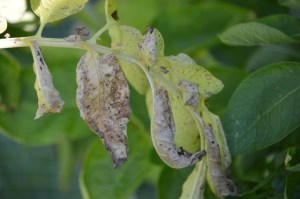
If critters and weeds are not enough to deter any sane person from undertaking this hobby, the myriad of possible plant diseases and fungi might! My father gave me a copy of Rodale’s Garden Answers which contains sections meant to help identify what disease might be attacking and what to do about it. DSC_0097So many of the symptoms are frustratingly similar that by the time you take an educated guess, the plant could be beyond help. Sigh! I’ve seen plenty of powdery mildew taking out stands of Black-Eyed Susans. And two years ago, I watched my potato plants wither away, one by one, from blight. There’s also the challenge of trying to determine whether it’s an insect or a disease that’s causing a plant to wilt, turn funny colors, curl up, and die.

It’s truly a wonder that any gardens produce beautiful blooms or edible fruits. Yet, they do. I have a few gallons of strawberries and raspberries stored in my freezer as proof. Pea pods, tomatoes, potatoes, zucchini, and cucumbers await my attention outside my door.

As I wander around the grounds, I find myself already mapping out next year’s potential garden beds. Maybe next year I’ll be more prepared, more pro-active. Maybe I’ll beat nature at her own game.

Not.

DSC_1000